 It is ironical that perching, the ‘third way’ in the sit-stand conversation, first became topical a few decades ago during discussions about standing too much!
Historically, there have been many logical applications for perching in manufacturing environments as a way to reduce the standing time for machine operators and process personnel without the productivity loss which can arise from frequent changes between sitting and standing. You will also see perching stools in galleries and museums so that attendants do not have to stand for their entire shift. The principal benefits of perching in such situations are an open pelvic angle for better spinal posture; reduced risk of slouching thereby encouraging better breathing; quicker and easier transition to standing height which can impact productivity and, in customer-facing applications, better eye-contact with others who are standing.
There are several ways of achieving a perching posture in an office application and chair designers and manufacturers have created many innovative approaches to the topic – with varying degrees of success! This article will not be an analysis of these different approaches but I will use three office-focused designs to illustrate the diversity available and help you to make your own decisions or, at least, ask the right questions. It is quite possible that other chair promoters and manufacturers will respond with ‘why mine is best’ comments below! As always, my advice is to beware of advertising disguised as advice.
 For a modern approach to the traditional ‘bus stop’ perch, the Muvman provides a simple, comfortable seat with a spring in the height-adjustable stem and a patented movable joint in the base. This allows a dynamic sitting posture with natural movement which most people find ‘surprisingly comfortable’. The only adjustment is for gas-stem height and, for stability, the base has no castors and is quite heavy.
 The saddle stool concept is widely available in a range of shapes and sizes. This sort of seating is popular with dentists, podiatrists and in some manufacturing environments but less common in offices. The saddle posture allows the user to sit at, typically, 50-70% of standing height but it is important to specify a gas stem that will go high enough (this may not be the default option). For anatomical reasons, an adjustable forward tilt will usually be desirable for male users. It is also important to note that it is not easy to judge what shape saddle any individual will prefer. Over the years, we have experimented on the basis or male/female pelvis shape, buttock width and thigh girth – without arriving at any reliable conclusions! If you are purchasing for an individual, be sure to carry out a trial first and if you are buying for multiple users, choose a mixture of models. Be aware, also, that some users simply cannot live with the saddle concept.
 The Capisco has been established for many years and takes a very different approach. With a suitably high gas stem, this chair offers traditional sitting, saddle-style sitting and reverse sitting (with the chair back supporting the sternum). Some employers also use these with fixed-height high desks, adding a foot ring to allow a traditional sitting posture at height. For employers who want dynamic sitting and a stylish, unique look, Capisco can be used as a single solution to the sit-perch-stand approach.
Other models, each with their own story, can be viewed on our web site here.
It is also worth considering how such models can be deployed. Many may require both a traditional chair and a perching stool/chair. Do you have enough space? Alternatively, can you provide sit-stand (or stand only) desks without a traditional chair and just the sit-perch option?
As always, it is essential to ensure that, whatever configuration you decide on is fully supported by quality training.


 Posted by Guy Osmond
  My recent visit to Paris for the
  At the same time, I know it is hard work to establish credibility and reputation in a new market. I am probably too long in the tooth to start that again! In a developing market, I would offer end users just one tip – beware of advertising disguised as advice!
 Inevitably, sit-stand desks are a mainstay of the workplace part of this event. The conspicuous difference from the UK is that they are no longer a novelty. This concept is over twenty years old in Scandinavia and, in Denmark, it is now mandatory to offer sit-stand desks to employees. In a mature market, every manufacturer’s portfolio includes sit-stand and differentiating themselves from competitors can be difficult. The current focus is therefore on aesthetics and many companies are hiding most of the essential steel components by encasing them in wood. I thought it was significant that I saw no evidence of the gimmicks such as illuminated desktops and hands-free height adjustment that are gaining ground in the USA. There is also no discussion about whether or not people use adjustable desks (a preoccupation in the UK): sit-stand is part of the regional culture.
 Scandinavia has been in the vanguard of workplace seating design for many years and the key regional manufacturers were all represented. Task chairs continue to evolve, offering greater comfort, more intuitive adjustment and improved aesthetics. A strong sustainability story is no longer topical since that too is now ‘business as usual’. As Aleksander Borgenhov, one of the designers, summed up the development process, the objective is to create ‘a beautiful object from something that is, in fact, a highly advanced machine’.
 Acoustics is one discipline where the design of decor and furniture merge. ‘Sound ergonomics’, as I like to think of it, is a fascinating topic. Many high back sofas, huddles and pods for varying work areas incorporate acoustic benefits into the design and its importance is now widely recognised as we grow to understand more about the links between wellbeing and productivity. One of my favourite furniture products addressing these issues is the cocoon-like
 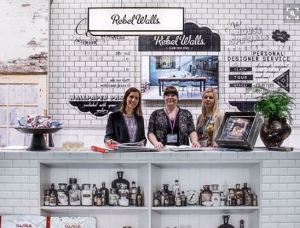 My favourite product? Actually my second favourite product (see below) but, completely randomly, I spotted the Rebel Walls stand when I stopped for sushi at lunch time. Their 3D trompe l’oeil wallpaper is stunning and the scope for bespoke designs is very clever. I shall be visiting
  It is nearly twenty years since we sold our first sit-stand desk but the real growth in interest amongst UK employers has arisen since early in 2014.

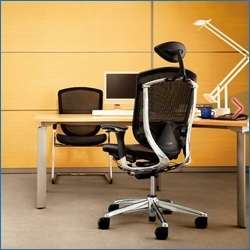 Despite being one of the largest furniture manufacturers in the world (2015 turnover > £1.2bn), Okamura products are a comparatively well-kept secret in the UK. With models to compete head-on with iconic office chairs in terms of style, quality and ergonomics, we are delighted to include them in our portfolio. From the
 Agile Working is a ‘hot topic’ at the moment and we hear many stories about how brilliantly employers have implemented an Agile Working Programme (AWP). Such accounts demonstrate how that success has positively impacted productivity, personnel satisfaction, wellbeing and engagement. We hear rather fewer stories about what happens when it fails but I fear that proper investigation would show that the failures outnumber the successes. [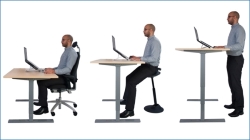
 We have just booked our space for
 The commercial and productivity arguments for good staff health and wellbeing are now manifest and dynamic employers have this at the centre of their business thinking. This new
  Optima-life works with organisations that want to help their employees achieve more, both at and away from work. Their salutogenic approach aims to keep people energised and resilient, as they seek to engage and educate people. Using a blend of technology, coaching/training and support tools, the team provides bespoke offerings tailored to an organisation’s needs. The result is a culture where performance and purpose are increased and the risks of organisational stress, fatigue, and burnout are reduced.
 ‘Human Factors and Ergonomics in Practice: Improving Wellbeing and Performance in the Real World’ is a new book about HFE as it is actually applied in day-to-day life. It is edited by Steven Shorrock and Claire Williams and contains an impressive list of international authors. Amidst the distilled knowledge of this august and international body of professionals is a chapter by me! The book is due to be published in Summer 2016 but you can find much more information in the extensive
 We have just booked our space again for the NBE
  Did you see our April Fools’ Day email, blog or web site? With new, and often conflicting, research appearing almost daily, it is hard for business managers to know what guidance to follow. To confuse everyone further, we announced a new recommendation that ‘Work routines should be broken at least once an hour with a short sleep of 3-7 minutes’. In the end, nobody asked us for more information about the ‘sleep walking treadmill desk’ and we spent far more time on this nonsense than we should have, but it was fun! If you missed it, take a look at
  As the debate about too much sitting rages on, there are many misunderstandings. ‘How much should I stand at work?’ is a question we are asked frequently but, like ‘
 Prompted by the disparity in advice and encouraged by recent conversations with professional colleagues and friends, I have been looking for research-based recommendations that we may be more confident about. As a result, I have been reading ‘




 Osmond Ergonomics