I have addressed the choice of a work chair for yourself or for whole teams elsewhere.
 This article assumes you have already ordered a suitable quantity of general chairs – or already have them – and now need a procedure to address the needs of those who find the standard option unsuitable, uncomfortable or inadequate. This may be due to dimensional issues (too big/too small/ too wide/too narrow), musculo-skeletal problems (such as back or neck issues, upper limb disorders) or because of disabilities (spinal curvature or limb amputation perhaps).
To ensure consistency of approach, it is most important to establish a procedure for exception management. If it is not clearly defined and strictly observed, there is a real risk that the exception may start to become the norm or that those who shout loudest (not necessarily the most deserving) get the most attention.
Whilst there will be obvious individuals who will not fit the general chair for dimensional reasons, there will be others with less obvious musculo-skeletal or health conditions. The approach should be the same for all of these situations and the most likely triggers for exception management will be:
- Escalation as a result of a workstation assessment
- Recommendations from a medical professional such as a GP or physiotherapist
- Self-reporting
To elaborate on these,
- The workstation assessment is the most reliable trigger and it is important to have a robust procedure in place. There are many computer-based systems and the best will provide much of the reporting and escalation structure. Where a manual system is used, it is essential to review assessment reports promptly. Employers producing assessments and failing to act on the outcomes are simply creating evidence to be used against themselves in the event of litigation!
 Whilst any report from a medical practitioner should be taken seriously, it should be reviewed carefully if the practitioner proposes any physical or product interventions but does not have an Occupational Health background. GPs, physiotherapists, osteopaths, chiropractors and others have been known to recommend a specific chair model or, perhaps, a ‘swiss ball’. However, they are not usually product specialists and any suggestion will almost certainly be simply a personal preference or based on literature they have read, rather than a holistic approach to the individual’s workplace needs. Their suggestions may not even comply with appropriate legislative requirements! If you have your own in-house occupational health facility, its personnel will almost certainly be in contact with one or more ‘ergo suppliers’ and will therefore have a much better understanding of what products are available and appropriate.
- Whilst self reporting should be an option available to all, your procedures should always validate the justification for any escalation. It is therefore most likely that the initial discussion will lead back to 1. or 2. (or both) before any further escalation is approved.
 Once you have identified the need for specialist seating through one or more of these three methods, your process needs to manage the escalation and ensure an appropriate outcome. The next stages, and the parties involved, vary from country to country so, for the purposes of this article, the guidance will follow UK best practice.
The individual will now require a one-to-one advanced assessment which will pick up on the information already acquired. If the source of the escalation includes comprehensive data from the workstation assessment (1.) process, a telephonic assessment may be sufficient. If, however, reliable background, anthropometric and relevant medical information are not available, the one-to-one should be on-site in person. There will also be occasions when telephonic assessments become manifestly inappropriate and an on-site appointment becomes inevitable.
Approaches to the escalated assessment process (whether telephonic or in person) vary from employer to employer. The essential ingredient is to ensure that all the knowledge required for an effective outcome is available. The key knowledge requirements are:
- Understanding the contributory factor(s).
- This simply means having a good understanding of all the ergonomics and human factors considerations affecting the individual’s work and productivity. The physical considerations will be the most obvious but psycho-social factors will have significant impact so consideration should be given to how the individual enjoys their job, whether they feel supported by their manager and whether they feel in control of their workload as well as environmental factors such as heat, light, air quality and noise.
- Understanding what needs to be done to address these factors
- Typically, a medical professional will have this knowledge but may not be familiar with the nature of the work. Competent assessors will have been trained to be fully conversant with the necessary actions and will also have a network of advisers and contacts they can call upon for assistance and guidance where the specific requirements of the assessment are beyond their knowledge or experience.
- Knowledge of suitable physical and non-physical interventions. This is the most important contributor to a satisfactory outcome.
- Physical interventions will need a substantial knowledge of the various chair manufacturers and models available as well as the dimensions and features of these chairs and the adaptations available. Many manufacturers offer alternative chair sizes but a much smaller proportion offer a range of interchangeable seatpan and back height sizes, along with other modifications such as coccyx cut-outs, adjustable thoracic supports, massage modules, locking bases, etc. Assessors need to be familiar with these or be in close contact with someone who is. Research* shows that specialist ‘ergo’ suppliers are often the most qualified to provide such knowledge. These offer much more than traditional office furniture suppliers and will have a portfolio of specialist or adaptable products.
- Non-physical interventions typically take the form of changes in work practice and may involve variations in job role, hours, work location and mix of activities. They will almost always involve consultation with the line manager and/or HR.
Once the assessment and recommendations have been made, it is important for the employer to act as promptly as possible to carry them out. In many organisations, the process leading to the assessment can be protracted. Once the assessment has taken place, however, it becomes clear to the individual that progress is being made and they will expect a timely conclusion.
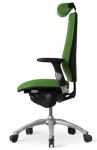 At the time of installation, the chair (and any other specified equipment) should be set up and configured for the individual with full training provided. The training, which is absolutely crucial to a successful outcome, should explain why the products were supplied, how they will help and how they should be configured and used.
The principal context for this article was to address seating issues but it should be remembered that ergonomics is a holistic discipline and the human factors of the user’s whole environment should also be considered. For example, an assessment of a tall person will almost certainly highlight desk and monitor height issues and a very obese person may need to consider a split keyboard to be able to type comfortably.
References
* Williams, C. & Haslam, R. (2006). Ergonomics advisors – a homogeneous group?
In: Contemporary Ergonomics 2006, (Edited by P.D.Bust), Taylor & Francis: Great Britain, The Ergonomics Society Annual Conference 2006, Cambridge, UK, pp. 117-121.
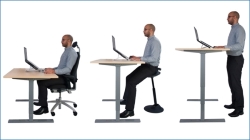
 It is nearly twenty years since we sold our first sit-stand desk but the real growth in interest amongst UK employers has arisen since early in 2014. Initially driven by publicity about the potential health impacts of sedentary behaviour, employers were bombarded with news, statistics, research and plenty of online ‘noise’ predicting dire consequences if there was not a rapid and immediate transition from traditional office environments to workplaces populated with ‘standing desks’. [more]
 I have been using an aircharge sleeve on my iPhone 6s for several months and, as well as protecting the phone, it is much more desirable than fiddling around with a Lightning connector cable when I need to recharge the battery. We offer aircharge facilities for staff in the office and I find it in a growing number of hotels, coffee shops and hospitality environments. Of course, in Clerkenwell, you can find aircharge in almost every showroom! For organisations wanting to offer this facility to their own personnel and visitors, there is a choice of options. The most common version – the surface charger – fits an 80mm diameter hole so it can be retrofitted to a standard desk grommet. Others can be incorporated into monitor arms and task lamps. See some of the variants here or contact us for further information. (If you are curious about the technology, you can find out more here).
 We originally set up the seatingexperts.uk web site alongside sitstandexperts.uk to reflect our knowledge beyond the specialist ‘ergo environment’. Working with a variety of manufacturing partners we now offer a broad portfolio of products to address every need in the workplace. The web site is still a work-in-progress but the sections for Reception & Breakout, Office Project, Modular, Meeting & Training Room and Boardroom have been completely redesigned. As mentioned last month, we are also working on a Comfort Score system to help buyers make a decision based on suitability as well as on aesthetics. More information about this coming soon!
 EnergiseYou helps innovative organisations to thrive by:


 Posted by Guy Osmond
  It is nearly twenty years since we sold our first sit-stand desk but the real growth in interest amongst UK employers has arisen since early in 2014.

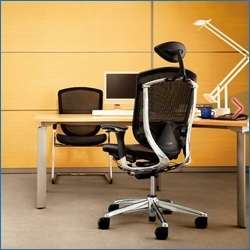 Despite being one of the largest furniture manufacturers in the world (2015 turnover > £1.2bn), Okamura products are a comparatively well-kept secret in the UK. With models to compete head-on with iconic office chairs in terms of style, quality and ergonomics, we are delighted to include them in our portfolio. From the
 Agile Working is a ‘hot topic’ at the moment and we hear many stories about how brilliantly employers have implemented an Agile Working Programme (AWP). Such accounts demonstrate how that success has positively impacted productivity, personnel satisfaction, wellbeing and engagement. We hear rather fewer stories about what happens when it fails but I fear that proper investigation would show that the failures outnumber the successes. [
 We have just booked our space for
 The commercial and productivity arguments for good staff health and wellbeing are now manifest and dynamic employers have this at the centre of their business thinking. This new
  Optima-life works with organisations that want to help their employees achieve more, both at and away from work. Their salutogenic approach aims to keep people energised and resilient, as they seek to engage and educate people. Using a blend of technology, coaching/training and support tools, the team provides bespoke offerings tailored to an organisation’s needs. The result is a culture where performance and purpose are increased and the risks of organisational stress, fatigue, and burnout are reduced.
 The
The 
 Almost every office furniture supplier now offers sit-stand desks in their portfolio. Most of them have no understanding of the potential culture change that they bring and many provide
  At the
  For other organisations, the picture is much more diverse.
 End of the Aisle and Fixed Percentage programmes nearly always use
  Finally, and contrary to much of the publicity around this topic, this whole issue is not about standing more but about sitting less. To be fully effective, therefore, sit-stand should be part of a broader wellbeing initiative that encourages more movement.







 Osmond Ergonomics